Investigate strange oddities on the Ornament Express, where you’re hired as a detective to recover your client’s belongings from an eccentric thief and his train of stolen artifacts. Explore a cabinet of curiosities throughout the train, visit carts holding odd puzzles, odder objects and find hidden valuables.
A drawer being used to store a bird
Spline System in VR
As a system designer I developed a spline-based drawer system that facilitated the seamless creation and integration of interactive items within the game. This system allowed players to grab and move objects along a spline trajectory. Level designers benefited from the flexibility provided by this system, as they could easily create these interactive items using the level editor. Moreover, the spline-based drawer system served multiple purposes within the game, such as implementing sliders for audio settings, creating handles that could be pulled to enter different levels, and enabling doors to be smoothly slid open.
Sliders being used to set audio volume
A drawer being used to store a bird
Spline System in VR
As a system designer I developed a spline-based drawer system that facilitated the seamless creation and integration of interactive items within the game. This system allowed players to grab and move objects along a spline trajectory. Level designers benefited from the flexibility provided by this system, as they could easily create these interactive items using the level editor. Moreover, the spline-based drawer system served multiple purposes within the game, such as implementing sliders for audio settings, creating handles that could be pulled to enter different levels, and enabling doors to be smoothly slid open.
Buttons being used to enter a code
Tactile Buttons in VR
Buttons play a crucial role in VR interactions, and I dedicated significant effort to ensure an immersive experience. In many VR games, buttons typically have two states: pressed and not pressed. To enhance the user experience, I implemented a more realistic behavior, where buttons needed to be pressed further and moved along with the user’s fingers, simulating the visual and tactile sensation of pushing a real button. Additionally, I incorporated haptics that provided feedback when the buttons were fully pressed, adding an extra touch of polish.
Buttons being used to enter a code
Tactile Buttons in VR
Buttons play a crucial role in VR interactions, and I dedicated significant effort to ensure an immersive experience. In many VR games, buttons typically have two states: pressed and not pressed. To enhance the user experience, I implemented a more realistic behavior, where buttons needed to be pressed further and moved along with the user’s fingers, simulating the visual and tactile sensation of pushing a real button. Additionally, I incorporated haptics that provided feedback when the buttons were fully pressed, adding an extra touch of polish.
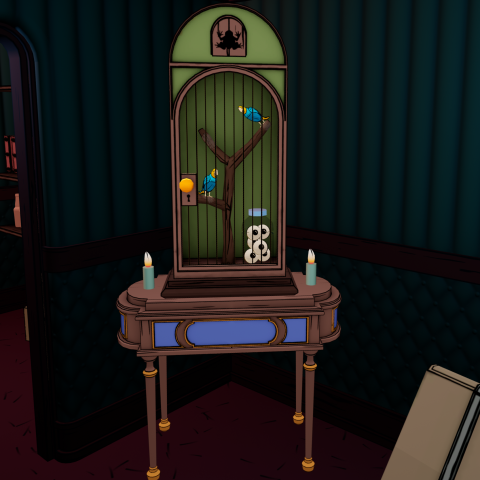
The bird cage that is part of the puzzle
Playtesting and Player experience
One of the core components of our game is the bird puzzle, and I took charge of its development. Throughout the process, I focused on refining the puzzle by introducing several meaningful features, while foccusing on the player experience.
While working on the puzzle cage, I encountered an development challenge; the bird didn’t fit inside the cage as intended. To remedy this, I creatively positioned the bird upside down, resulting in a humorous visual. During playtesting, we discovered that this quirk didn’t hinder players’ progress. In fact, it often elicited a chuckle, adding an enjoyable and lighthearted moment when players completed the puzzle.
To enhance the overall experience, I incorporated subtle tweet sounds that added to the ambience of the train cart, as well as helping the player locate the birds. Decals were added to help the player figure out the placement of the birds, and I created a tweeting sequence to replace a non diegetic puzzle completion sound that additionally pulled the players attention to the opening cage door for the puzzle reward.
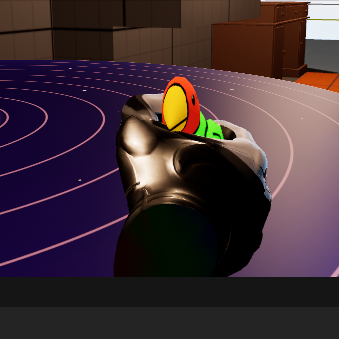
The bird with a custom hand pose
The bird cage that is part of the puzzle
Playtesting and Player experience
One of the core components of our game is the bird puzzle, and I took charge of its development. Throughout the process, I focused on refining the puzzle by introducing several meaningful features, while foccusing on the player experience.
While working on the puzzle cage, I encountered an development challenge; the bird didn’t fit inside the cage as intended. To remedy this, I creatively positioned the bird upside down, resulting in a humorous visual. During playtesting, we discovered that this quirk didn’t hinder players’ progress. In fact, it often elicited a chuckle, adding an enjoyable and lighthearted moment when players completed the puzzle.
To enhance the overall experience, I incorporated subtle tweet sounds that added to the ambience of the train cart, as well as helping the player locate the birds. Decals were added to help the player figure out the placement of the birds, and I created a tweeting sequence to replace a non diegetic puzzle completion sound that additionally pulled the players attention to the opening cage door for the puzzle reward.
Flow manager / Strike Team lead
During the initial stages of the project, I served as a Strike Team Lead, responsible for supervising a team of approximately 6 developers. This role involved conducting daily standups, organizing sprint planning sessions for our section of the team, and providing support to ensure the team’s productivity and timely delivery. Additionally, I prioritized the well-being of team members, ensuring they maintained a healthy work-life balance even in stressful situations.
In the later phases of the project, my role transitioned into that of a Flow Manager, overseeing the entire team consisting of around 15 developers on a daily basis. As a Flow Manager, my responsibilities closely resembled those of a Strike Team Lead, but with an added emphasis on identifying dependencies and assisting individuals who encountered difficulties. I actively supported them by providing direct assistance or by facilitating collaboration with other developers to address specific challenges.
Additional team roles
On this team I also took the roles of both marketing and hardware maintenance.
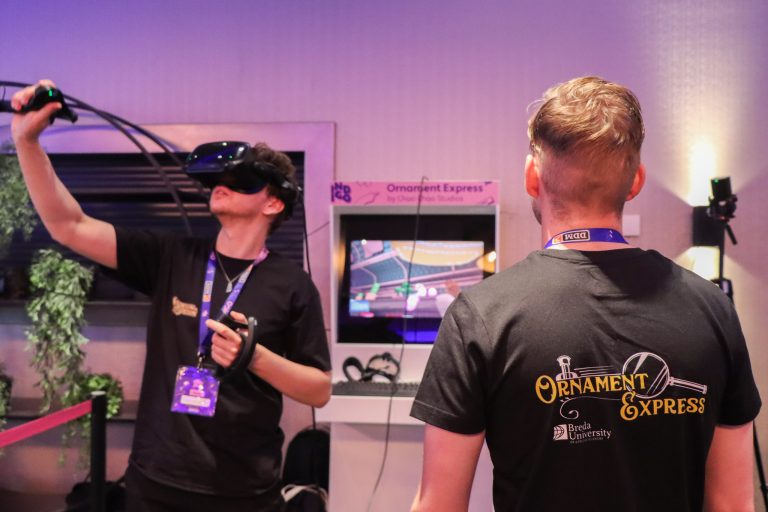
For marketing a large part of my role was outreach to Steam and awards. We were featured during Steam Next Fest and Steam Puzzle fest in popular upcoming. We were also selected for the INDIGO Discovery Showcase where we had many people play our game on the showfloor. Additionally we were nominated for the Dutch Game Awards and Bafta Student Awards.
As hardware lead I was responsible for facilitating developer hardware on campus, in addition to hardware during playtests and showcases. This gave me a lot of opportunities for additional collaboration with my peers.